I once owned an expensive Kenwood handheld – perhaps a TH-D74 – that I had been excited about because I wanted to try APRS. To get on APRS at the time the option was to buy an expensive radio or to piece together (or home-brew) the audio interface, a GPS and the board to pull that all together.
Recently, Chinese radios have started to integrate these in reasonably priced handhelds so the last couple of weeks I’ve been trying the Vero VR-N76.

It’s a modern radio in the sense that you can program it over bluetooth as well as using the bluetooth (with it’s own app, or a generic app using the built-in KISS terminal) for doing APRS.
APRS
APRS – Automatic Packet Reporting System – is for sending telemetry packets over amateur radio. Packets can be repeated ‘digi-peated’ by radios set up for this to form a bit of a mesh. There’s no flow control, but packets contain some ‘path’ information which is altered when they are repeated so they don’t live forever and flood the network. Packets can also be ‘iGated’ onto the internet, which is a useful way to check your packets are getting out.
This image is from the very popular aprs.fi that can be used to view packets containing location information.
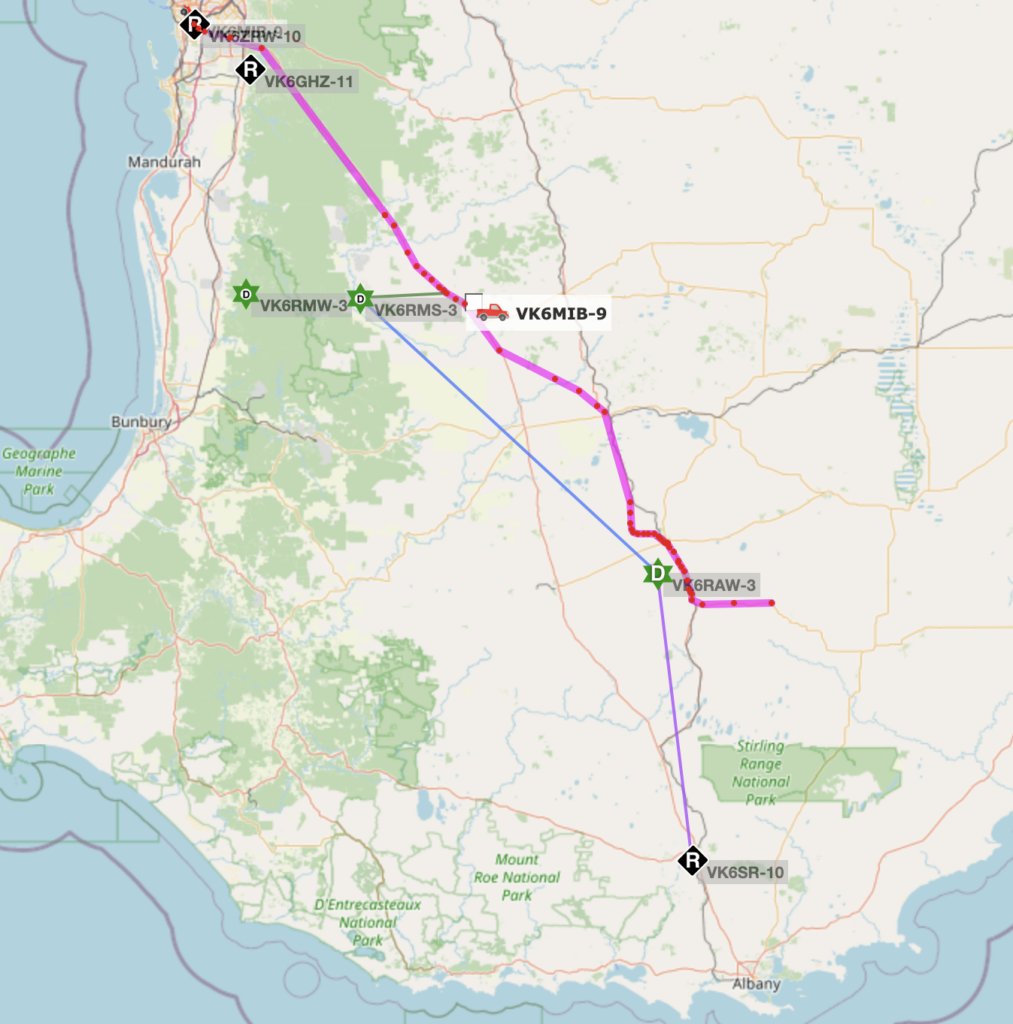
Here’s a trip from today. I’ve hovered over a packet sent from Albany Highway near Boddington. You can see on the map my packet was digipeated by VK6RMS at Mount Saddleback, then again by VK6RAW at Katanning, then iGated to the internet (but not repeated) by VK6SR at the Mount Barker repeater site. Here’s the packet that was iGated:
2026-01-07 18:07:45 AEDT: VK6MIB-9>APN000,VK6RMS-3,VK6RAW-3,WIDE2*,qAO,VK6SR-10:=3255.63S/11644.28Ek305/059/A=000925146.5 / 439.150
A few minutes later my packets were taking a different path:
2026-01-07 17:06:28 AEDT: VK6MIB-9>APN000,VK6RMS-3,VK6RMW-3,WIDE2*,qAO,VK6ZRW-10:=3306.66S/11656.61Ek321/052/A=001108146.5 / 439.150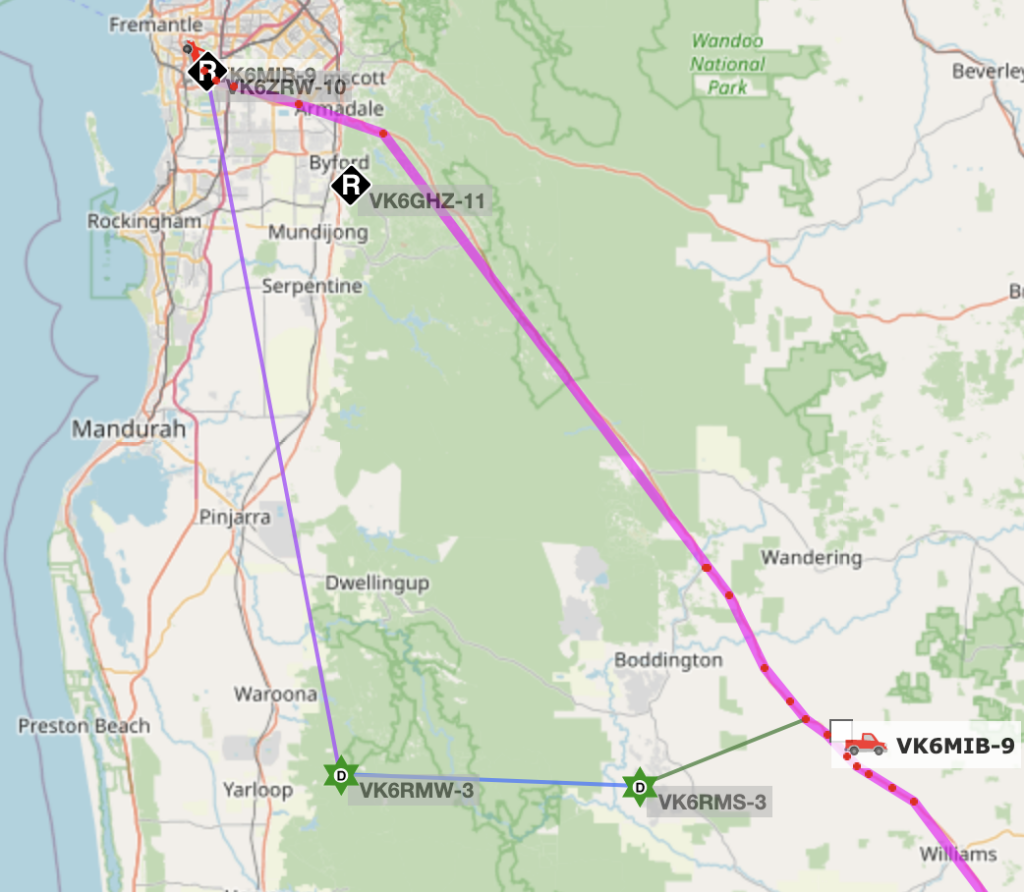
Shout out to everyone involved in building and maintaining this infrastructure, – in this case WARG & Southern Electronics Group.
 NO84
NO84

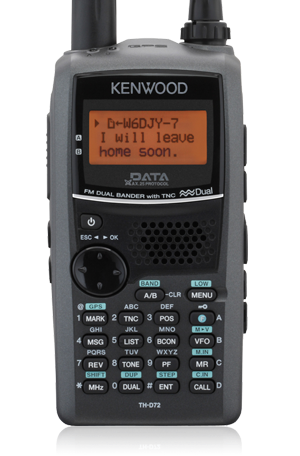 With a long weekend, and a major project at work behind me, I had a tiny bit of breathing space to play radio this weekend. What I should have been doing is putting in a couple of hours on the AllStarLink for my club (currently at about 30% finished). What prevented this was a new toy scored second-hand from eBay that arrived this week – a Kenwood TH-D72A handheld.
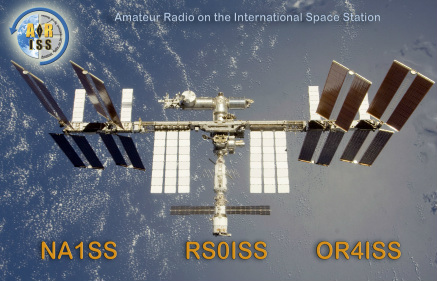 I grabbed this off eBay, the main attraction being it’s APRS capability, including: built in GPS, stand alone digipeating, and the ability to plug it into a PC and use it as a TNC. My first big plan for this, since I’m miles from anywhere, was to use it to get my staion on the